
Designed following the model of Ebenezer Howard’s garden city, Fertilia is perhaps the only planned town from the fascist era that has preserved intact the characteristics of rationalist architecture from the ‘ventennio’ period. These elements are framed by lush, green nature, recalling and enhancing its auspicious name. Located in northwestern Sardinia, opposite the Catalan-Aragonese city of Alghero, the settlement was officially founded on March 8, 1936, bringing to life the utopian vision of Mario Ascione. He saw in the reclamation of the marshy plain of Nurra the opportunity to create a flourishing and self-sufficient community with a strong rural economy. In reality, land transformation efforts had already begun in the late 19th century with the drainage of the Calich coastal lagoon, carried out by inmates from the nearby penal institution of Alghero and the Cuguttu penal colony. This work continued with the creation of Villaggio Calik in 1927, designed by engineer Pier Luigi Carloni.
This initial group of Neo-Medieval style buildings, intended as warehouses, dormitories for workers, and administrative offices, formed the oldest nucleus of Fertilia. It also served as the starting point for what, from 1933 onwards, would become the “integral reclamation” concept promoted by the fascist regime and carried out by the Ente Ferrarese di Colonizzazione (Ferrara Colonization Authority), of which Ascione was president and director from 1934 to 1943.
Slightly more than a hundred families from the lowlands of Ferrara, an area then facing significant demographic pressure, settled on equally distributed farmsteads laid out in a regular grid pattern. They cleared Mediterranean scrub, plowed the land, and dug deep drainage canals to make otherwise marshy lands cultivable and productive. This relationship between the surrounding rural areas and Fertilia itself, along a straight road axis connecting it to the village of Santa Maria la Palma, established an organic link between rows of colonial houses and the urban center, which was designed to provide essential services.
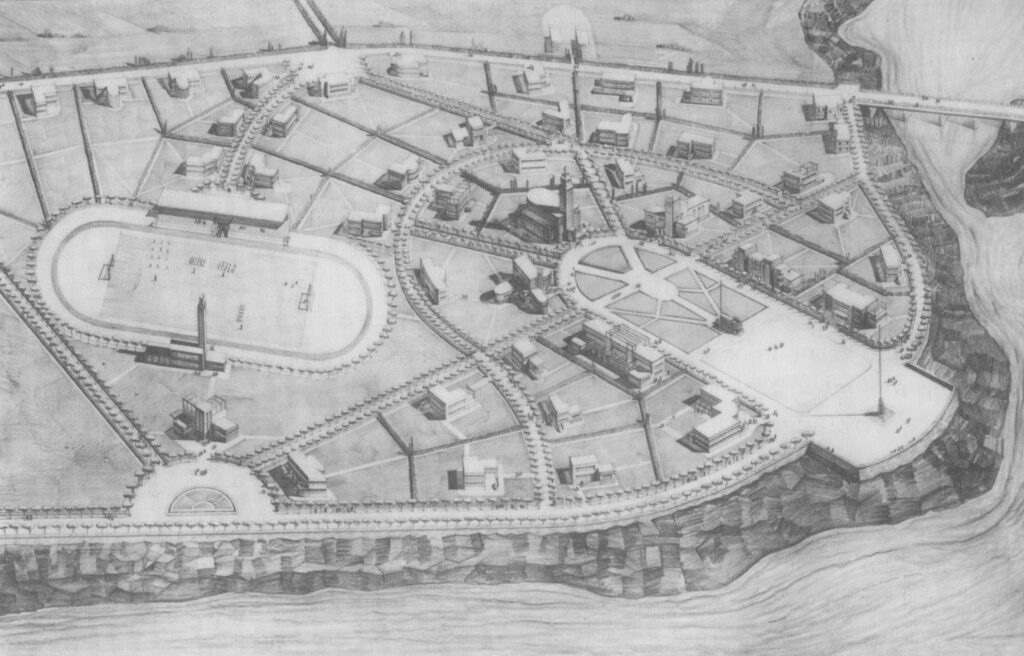
In the urban core, two main squares were planned in contrast to each other:
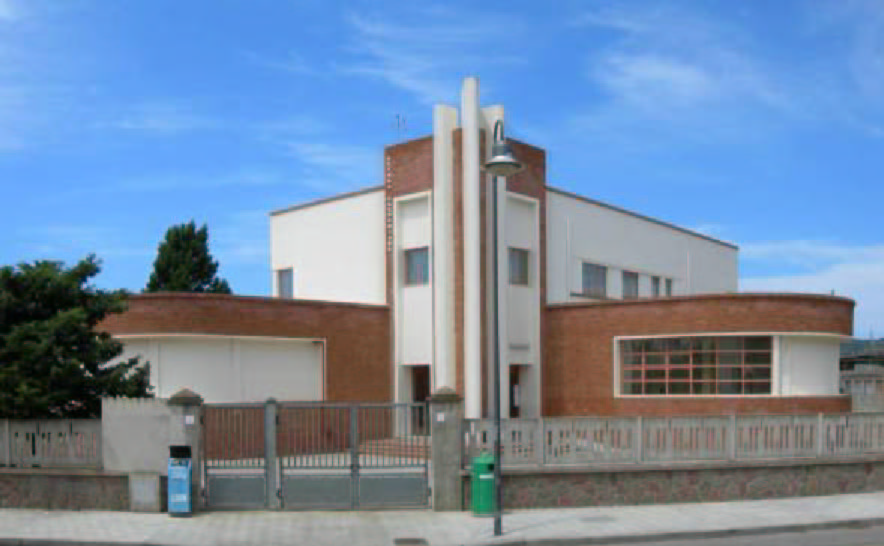
- Piazza Venezia Giulia – Designed in 1935 by engineer Arturo Miraglia, it was semicircular (exedra-shaped) and hosted the church and elementary school. The school was the only building constructed in accordance with the original plan, described as a “highly rationalist, bold structure with multiple protruding sections, gleaming glass, and shining metals.”
- Seafront Square (Planned as “Piazza 9 Maggio”) – This square embraced the Town Hall (Casa Comunale) and the Casa del Fascio, with twin towers at the two extremes of the urban space. It also featured a hotel, cinema-theater, and a magnificent Belvedere, symbolizing the prow of a ship projecting towards the sea. At its center, a travertine-clad obelisk supported a bronze statue of the Winged Lion of Saint Mark, a work by sculptor Giuseppe Silecchia, commemorating the Giulian-Dalmatian exiles who arrived in 1947 to build and bring to life the architectural vision of architects Petrucci and Tufaroli, and engineers Paolini and Silenzi.
A third square, never built, was planned near the main crossroads leading into the town as a large space dedicated to commerce, markets, and fairs.
The 2PST group, winners of the 1936 competition for Aprilia’s master plan in the Agro Pontino and later for Pomezia, were commissioned by Hon. Ascione to revise Miraglia’s original design. His initial concept was considered too detached from a cohesive urban fabric and overly focused on isolated monumental buildings. In 1937, the new plan established a unified architectural structure, aimed at:
- Eliminating unnecessary and costly construction complexities
- Restricting reinforced concrete to horizontal structures
- Using local stone for facades
- Incorporating tiled roofs
- Providing the town with a distinctly Italian and Mediterranean identity
The Town Hall, located on the east side of the seafront square, is the only representative building featuring modest decorative elements, such as flat pilasters and recessed rectangular panels set into a trachyte stone façade. Marble flooring and wall coverings were used exclusively in the church, which houses stunning mosaics by Giuseppe Biasi, a renowned Sardinian painter, along with ceramic artworks by Giuseppe Silecchia.
The remaining buildings are devoid of ornamentation, adhering to strict functionalism. Load-bearing structures are made from local limestone bonded with lime mortar, while base moldings, door and window frames, and visible stone facings were crafted from trachyte sourced from nearby Ittiri. The wooden fixtures and cement-granite flooring further reinforce the austere simplicity of the design.
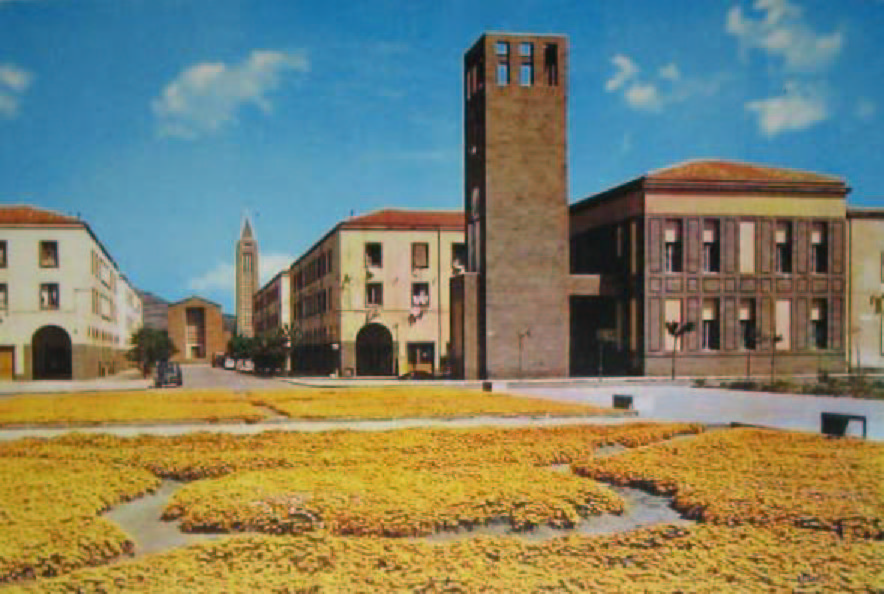
A panoramic view of Fertilia reveals a timeless atmosphere, akin to stepping into a De Chirico painting. The rhythmic arches of the church façade and the porticos along Via Pola, supported by wine-colored trachyte pillars, define simple, clean architectural volumes.
Despite the passage of more than seventy years, the modernity of these buildings remains striking. The broad streets and spacious squares reflect a forward-looking urban vision, anticipating future needs and trends.
The impressions conveyed are those of peace and serenity, thanks to the harmonious integration of human-made spaces with the surrounding natural landscape. This setting serves as a reminder that the principles of early modernist architecture, rarely seen in contemporary urban contexts, represent one of the last great expressions of Italian architectural culture on an international level.
Arch. Michele Rosa
Scarica la relazione storico-culturale con tutte le immagini